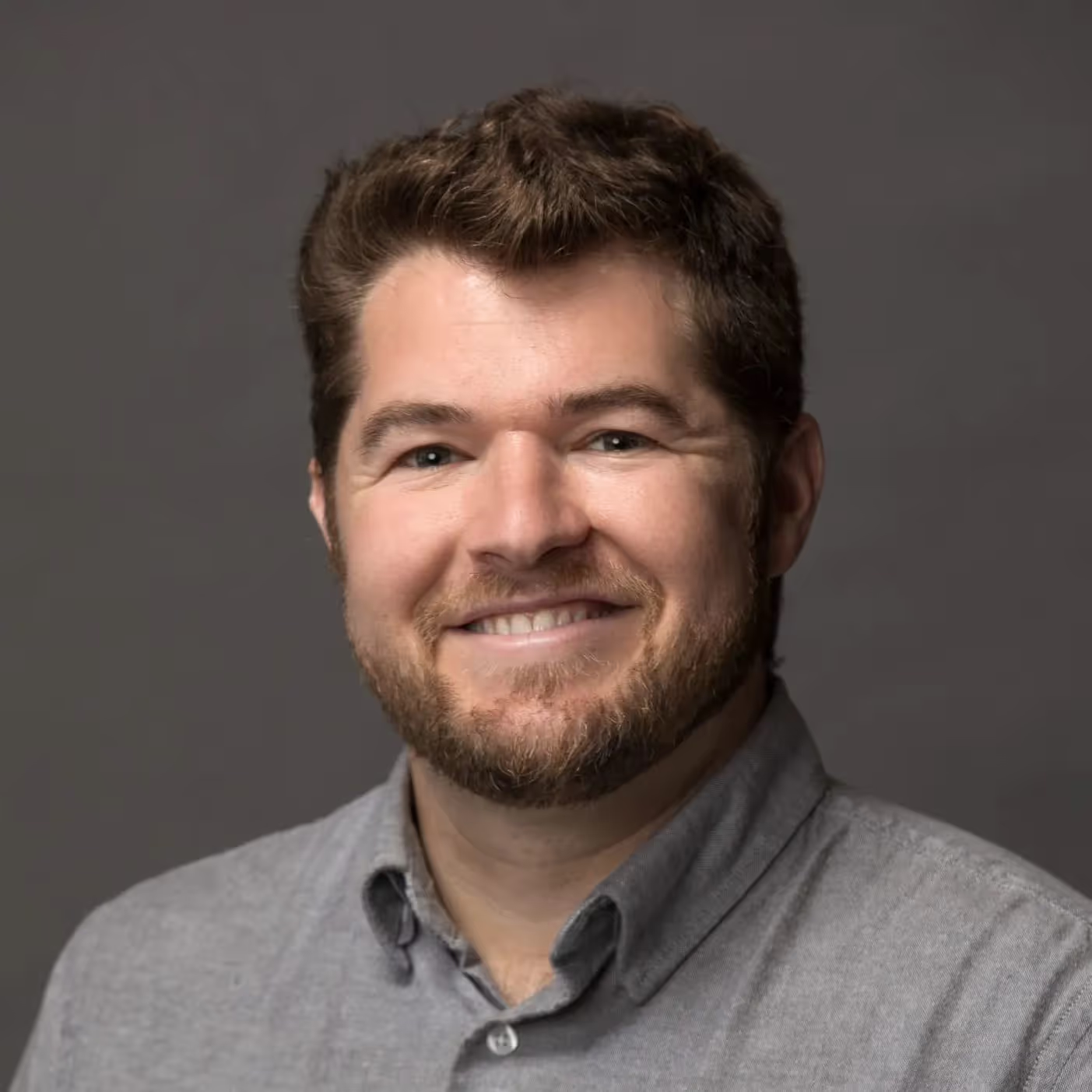
Jason Kirby (00:09.225)
Hey everyone, welcome back to $100 million exits. And speaking of $100 million, today we have Chris Rudigrap with us, founder and CEO of Sendosa, who not only has surpassed $100 million in revenue, but also raised $100 million from the infamous SoftBank. Chris, welcome to the show.
Kris Rudeegraap (00:26.456)
Yeah, thanks for having me on, Jason.
Jason Kirby (00:28.477)
So let's start with that. SoftBank not too long ago was all the big announcements, the big capital deployments, and you guys are in the tech enabled corporate gifting space and you raised 100 million from SoftBank several years back. Walk us through what it's like pitching SoftBank and getting a hundred million dollar check.
Kris Rudeegraap (00:52.716)
Yeah, so just at this stage in timing, so SoftBank came inbound from an intro from another one of our investors, late Q3 of 2021. They had already seen and heard about us, so they came in with pretty savvy kind of background, almost in the sense of like pitching us on how we were ready to continue to explode our growth, which was nice.
And so it was, you know, went from a coffee meeting quickly escalated, you know, within a couple of days to a pitch deck, to some of their internal partners. And then about two weeks later, it was time to present to Masa. That was an interesting one because basically they told me, hey, you've got, you know, the next six, seven days, block your entire schedule. I'll give you a heads up the day before he's ready. And then that's your go and that's your go time.
I will say one bummer thing, this is just exiting COVID. I heard stories previously where he'd pick you up on his private plane and fly you back to Japan to pitch in person, but I just had to wait around for that Zoom call.
Jason Kirby (02:04.31)
Zoom call. Brutal. It worked.
Kris Rudeegraap (02:05.779)
I know. It worked, it was fun.
Jason Kirby (02:11.123)
So you missed out on the private jet, but yeah, you got $100 million. So yeah, not too bad. So what was it like? What's a Zoom call like with Maslow?
Kris Rudeegraap (02:12.94)
Yeah, exactly.
Yeah, so I mean, he had a large team on it. I want to say another dozen people, but for the most part, he was there. He was super knowledgeable on the background of the business, which I was impressed with. He asked some targeted questions about how we saw the growth ahead. He was also bantering with two of the partners in the US that were kind of representing and potentially our future board members about their interests. not only was he kind of, you
quote unquote interrogating me, but he was also asking a lot of questions about the partners and how they saw Sendoso's growth ahead. But honestly, it was a lot of great questions. And then from there, he said, thank you. And then it was a couple of later before we got the term sheet.
Jason Kirby (03:06.569)
What was that couple weeks like? Was there a lot of back and forth with their team or was it like silence?
Kris Rudeegraap (03:11.886)
So it was actually quite fast. And with that, was a lot of their team asking me details, making sure that everything was lined up and ready to go. Because once they signed the term sheet, they wanted to run with it, it's next step. it wasn't like a dark period or ghosting me. It was more like, okay, this is the process over the next week. We're going to talk details. Then we're going to get this written up. Then you're going to go and sign. then the money did take a little bit delay to get.
wired because there's some like international if it triggers some like international wire transfer, you know, Homeland Security, something like that. I recall that I was like, why can't you just wire that today? And it was like, I think it took a couple months to wire.
Jason Kirby (03:56.925)
Couple of minutes, woof. That's painful.
Kris Rudeegraap (03:58.624)
Yeah, there was some period in time where you had to fill out some paperwork with some government entities, because it was coming from a foreign entity. but, you know, it wasn't like we were in desperate need of the money. was just more of like the process, but they were really transparent in the process. So wasn't like painful. was just different than say my series A and B, which was like, you know, once you sign, you're like, boom, here's your money. or even my, my first check from my seed round.
Jason Kirby (04:13.572)
Yeah, even when you get hungry.
Kris Rudeegraap (04:27.79)
the board member, came and walked me over and gave me a physical check, which was kind fun.
Jason Kirby (04:32.84)
That's nice gesture. So you go through this entire process and it's unsolicited. So they came to you to pump you full of cash and with expectations for growth. What was it from that point of like, congratulations, Chris, you now have $100 million more in your bank account. What did you do?
Kris Rudeegraap (04:55.808)
Yeah. So we went and started aggressive plan mode. know, so this was again, end of Q, like mid beginning of Q4 when this finished up. So we said, Hey, let's plan for this next quarter where we can't immediately, you know, make any big changes. Let's kick off the year with this grand new plan with a hundred million dollars. So we spent a couple months leading into the holiday of the end of 2021.
headcount hiring planning, sales forecasting, budget planning, really rethinking our entire business now that we have this influx of capital and now that we had this more aggressive growth plans because as part of that 100 million, there was kind of this opportunity to say, hit growth milestones and there'll be more money to fall.
Jason Kirby (05:48.146)
So.
How do you think about the scale you have to reach? Because at this point you've raised 165, because you had about another 60 that came in through your seed A and B, which we didn't really talk too much about. But you have $165 million dollar prep stack at this point. And I'm not sure if you, can you share kind of what revenue you were at that point?
Kris Rudeegraap (06:13.678)
we were probably mid 50 ish. I don't remember exactly, but, yeah. we weren't.
Jason Kirby (06:20.327)
Okay.
which is substantial, especially in 2021, like the imagine what was kind of growth like back then.
Kris Rudeegraap (06:28.91)
I mean, back then we were still doing kind of the doubling, tripling of revenues year over year because we really, you know, raised our first round in kind of going into 2018. So 2019, 2020, 2021. So we had some good growth years going into.
Jason Kirby (06:46.106)
No, it makes less sense. And so when you think about how you have to clear certain prep stacks and like scale this business to meet the expectations of SoftBank, what do you put as a target? Like how do you think about the market and expanding sales and investing in the right channels that are actually going to yield that type of growth?
Kris Rudeegraap (06:54.136)
You're
Kris Rudeegraap (07:08.254)
Yeah, mean, we, mean, prep stack wasn't even a worry. We were, you know, deck a billion dollar eyes lit up, you know, IPO in a couple of years, just on this, you know, you know, they were going to pump in hundreds of millions and more into the business to fuel growth. So it was really just how do we throw enough heads at this? Because this is again, pre AI era or pre this new kind of
AI agent, AI automation era. So it was really just like, you know, how many heads can we hire as fast as possible? Because at the time the math was, you more heads in sales equals more revenue and then everyone else to support.
Jason Kirby (07:54.902)
What do you set the targets to? Like, do you just make up a number? Like, okay, we got a triple because that's what everyone thinks we should do? Or is there a more methodical approach of like, we know that our threshold, like our LTV to CAC in this channel is profitable, less 10x spend there. Like, how do you think about the actual tactical implementation?
Kris Rudeegraap (08:13.108)
Yeah, I mean, it was a bit of tops down and bottoms up. So it was a bit of like, okay, where do we want to be if we needed to double the business again? And what would that look like? And then bottoms up, can we actually support this? And so that's where we needed to get more aggressive with our hiring because the bottoms up math didn't make sense to meet the tops down approach. So then we said, Hey, let's turn on the hiring flywheel. I think we quickly hired like 30 recruiters to
or maybe we already had probably like 10. So maybe we hired like 20 recruiters pretty quickly to then ramp up hiring across good market. So I think the goal was how do we get as many as SDRs, AEs, how do we get the marketing team ramped? And then how do we carry on and hire everyone post sales to support all this growth?
Jason Kirby (09:05.032)
And so, really I imagine you had some kind of unit economics on your go-to-market strategy that you guys are going to quadruple down on. I want to kind of jump ahead. This wasn't the planned chronological order of questions I wanted to ask, but now that we kind of brought up like investment in 2021, 2022 in SDRs as traditional play that was very much expected of any company just three, four years ago. How does that change today?
Kris Rudeegraap (09:28.396)
Yeah.
Jason Kirby (09:31.912)
with the advent of AI agents and AI proliferating kind of the go-to-market ecosystem.
Kris Rudeegraap (09:39.694)
Yeah. So for us and, you know, aside from the forcing function of kind of, you know, 22, 23, where we, you know, pivoted the business from growth at all costs to being more efficient. We can jump back into that, but specifically we had to make the bet, like, uh, as I would say, taking one step backwards to take 10 steps forward on our, on our outbound strategy, uh, because we had to move away from a tried and true proven.
strategy, which was just keep adding tons of heads and these, you know, SDR heads are doing very manual, very repetitive tasks, but that's okay because the formula works. You just add more heads, they book more meetings. and so we had to take a step back to say, let's, let's reimagine a world where we had less heads, maybe half as many heads, but we still wanted to get, you know, hit certain pipeline goals with this team. And so we, we really had to go and, you know, audit
every single minute of every day that these STRs were spending and figure out what parts of that could be automated through, for the most part, workflows. Some people call it AI. I'd say the first tack at it was more of workflow automations. And then we layered on AI for some of the message writing, some of the data.
kind of unstructuring and some of the data orchestration, but it was ultimately rethinking our approach from lots of heads to, okay, now can we use AI and data to figure out all the target accounts? Can we use AI and data to enrich all these accounts? Can we use AI and data to create hyper-personalized email sequences? Not what I would say mail merge, but...
rewritten sentences based on structure to then write that with AI to drive better personalization. And then how do we create email infrastructure to be able to send more? And then how do we roll that all out and retrain all the SDRs who are now refocusing their time away from manual tasks to responding to highly qualified replied emails in a unified inbox to phone calls to DOSO and other high value targeted
Kris Rudeegraap (12:02.42)
know, sales actions to book meetings. And so we, you know, shrunk the team a bit, but didn't lose some of the velocity we had. We just rethought about it differently.
Jason Kirby (12:14.516)
And were you guys, but I was still going kind of stepping back as to like what led to that focus of efficiency. You you raised the hundred million, there's promise of more, but ultimately you chose, or, know, it wasn't, you know, you to pursue more capital. So what, kind of happened from that? My OSSA son, like grow at all costs, like, and that was the era, like that was what was expected. And now kind of transitioning to more of like a real business making a hundred plus million in revenue and being
Kris Rudeegraap (12:29.645)
Yeah.
Kris Rudeegraap (12:34.722)
Yeah.
Kris Rudeegraap (12:41.902)
Yeah. So, you know, we raised that a hundred million Q4 kind of the end of 2021 went to start putting that to work in the beginning of 2022. And then I think it was like March ish of 2022 when the feds raised interest rates for the first time since 2018. Um, and then that kind of got all of our kind of got the entire world, uh, you know, especially our VCs to think, Hey, what's going on? And then, you know,
quarter or so after this kind of Zerp era, VCs started to pull back a bit. And our board specifically was more forward looking saying, hey, money's not cheap anymore. Money's going to change. You've got to figure out not this growth at all cost strategy. And so we really rethought and I think there's two bets to be made. You could either double down and say, who cares? We'll just keep spending a ton of money.
still play that growth at all cost game and cross your fingers that, you know, there is more money or you take control of your own destiny and, you know, stop burning as much cash and think about better economics to build a more sustainable cashflow business. And so we picked the latter of those. then, you know, and kind of re-strategized on what we had to do, which was
not hire as many people. was reduced forecasts significantly, reduced budget planning. And some of that was hard for some individuals on the team to fathom. Some was, you know, back to a more realistic numbers that was actually easier to fathom and actually back to kind of a real business than just propped up on venture dollars. And then it was just back to doing what we knew how to do, which was, you know,
go to market and sell our customers a solution they needed.
Jason Kirby (14:41.39)
What's that conversation like with VCs when you've made the choice you're going to focus on being a durable business and you present that to them and maybe the dekakorn aspiration is no longer on the cards and for a soft bank and the other investors that put in all this money and are expecting and or needing a return like that, what's that conversation like?
Kris Rudeegraap (15:09.71)
So I think there's a couple of different ways. One is I think in general, was, know, mid, late 2022, there was a general thesis amongst VCs and I feel like there was just some like shared Slack group where they all just went to the same bar and talked that it was like, hey, you know, the interest rates are going up, money's not going to be cheap anymore, so be strategic. And so it was not us coming out of left field saying, hey, new strategy, we're pivoting. It's more like, hey, good.
you know, we're all on it, we're all in this together. This is the smarter strategy. And it wasn't a strategy of us just giving up on our dekakorn, you know, goals. It was just, you know, I think the Zerp era, you just tried to compress time and you tried to run so much faster to get your goals. So it was just, we were just like, hey, instead of us, you know, maybe doubling in one year, it's like, maybe it's gonna take us two or three years to double again. So there's still like,
It's not like the demand for our business shrink or our product market fit changed or you know, there was any necessarily like anything broken it was just more of like, you know the fueling the fire with infinite money to grow faster than you could ever believe just changed and and so that was just an agreement to the board saying let's just like grow smarter than grow faster and in doing so just like, you know, re you know
rebuilding some of the core kind of scenario plans.
Jason Kirby (16:41.996)
And this is something that we were talking about before we got on the call, but part of that growth plan was acquisitions. And I want to kind of talk about what led you to that decision that acquisitions were a good idea and kind of what did that plan look like?
Kris Rudeegraap (17:00.396)
Yeah, so for the listeners, we've made two acquisitions. One acquisition was about two and a half, three years ago. One acquisition was about nine months-ish ago, I believe. Both were very competitors that were launched. One was launched about a year after us. One was launched about two, three years after we launched, but in a very similar space. And we computed them head-to-head in deals.
So there was, I'd say probably two ways we looked at these acquisitions. One was financially for us and how this was financially advantageous. And then two was like, how would the market and how would our customers like to see these acquisitions come to play? And so on the first one, financially, these acquisitions helped with inorganic growth. So it allowed us to quickly get
you know, hundreds of thousands of enterprise customers, tens of thousands of users, tens of millions of dollars in revenue overnight. It also balanced some of the competitive pricing pressures that occur when there's multiple competitors all at some points chasing to the bottom. It helped preserve some of our ACVs. It greatly continued to showcase our market leadership and our
category domination, which was nice. And then it also prevented another competitor from buying them first or another partner buying them, which was kind of a defensive play too in itself. So some was offense, some was defense on the financial side. And then maybe even more so on the customer side, and we've heard this from many customers where they didn't want so many choices in that, you know,
bringing these two companies under ourselves allowed for more R &D dollars to focus on innovation. So we were able to spend a lot more on really cool new features, which paid off in terms of our AI roadmap. Better economy is a scale. So because we're in the business of also having this kind GMV, e-commerce, marketplace-esque business inside of our SaaS business, we then can go and have better pricing power.
Kris Rudeegraap (19:16.742)
with our vendors and our suppliers, which we then can pass along kind of the Costco effect, I call it at points. So our customers now across the board get better cost of goods, which they love. So they're saving more money. And then I think ultimately, you know, this AI revolution we're in is all powered by how good is the data underneath it all. And because we have now data across three companies and a lot more, you know, data,
from all these different sends that we saw through Alice and through Postal and then through Sendosa over the years, that really amplified how precise our AI smart suite we call it is. And so I think that benefits our customers too.
Jason Kirby (20:01.991)
So clear strategic reasons to make the move. How did you decide which companies to buy? And what kind of process did you run? Did you hire an internal corp dev team? Did you outsource it? Were you deeply involved in every part of it? Did you have someone else leading it? What was that process like for you guys?
Kris Rudeegraap (20:24.566)
Yeah, so, you know, Kevin touched with all of our competitors over the years. And then, you know, it was probably around the SoftBank time where we got more serious saying, hey, nudge, nudge, you know, what, you know, one plus one equals 10. How do we come together? So there was a bit of courting them and kind of ongoing meetings to, you know, just build rapport, but also to showcase that we're serious. It was also...
You know, for, for Alice specifically, when we purchased them, they had a really strong enterprise customer base and really interesting AI data set. They were really early on in terms of like this, suggest the right gift based on, personal interest and based on AI. actually kind of, were marketing AI before AI was cool. And so we liked that. And so that was one reason we picked them first. and then it was, it also came down to the economics.
I think there is bit of ballparking the LOIs and doing a little bit of this dance on like, what kind of numbers can you share with me, even though you're competitive, so that I can then justify this to our boards, so that we can come back with a real LOI instead of these hypotheticals. so it was a little bit of building trust and getting some data that we could then make some models.
to then go back and get an LOI approved to then use that as a starting ground to then negotiate off of. I think that part's a little tricky because especially with competitors, there's this feeling like you don't want to share anything, even a revenue number. And it was, you know, to me, how do we break down that barrier of, of like, I don't want to share anything. I hate you to, Hey, like let's chat. And so that was really hard. But also.
you know, just time intensive to get that across. And then ultimately, you know, picking, looking at some models thereafter. So there was a big financial modeling, which is like based on customers, customer health, you know, projections, made sense picking one competitor over the other.
Jason Kirby (22:36.103)
So were you able to kind of get multiple competitors at the table to see all their data before, and then ultimately only chose one at the time?
Kris Rudeegraap (22:43.87)
no, not at the same time. So it was almost like, you know, we were able to get, Alice first, and that was based on them getting them to the table first while the others weren't quite ready. or we weren't there in terms of the numbers. Then after we bought Alice and it made the conversation easier to go back to all of our other competitors to then say, Hey, now we've got two.
you know, and now we were in a stronger position. and then kind of same process again, courting them, talking to them and sharing numbers, showcasing why combined entity could be better for everybody, including customers. and so that, then made the second one a bit easier.
Jason Kirby (23:30.203)
That's right. Yeah. You kind of built a little bit of trust when it's like, okay, they're legit. They're actually doing a transaction. They're not just like stealing our data and running away with it.
Kris Rudeegraap (23:35.862)
Yeah, exactly. And to your point, like I was spearheading some of the conversations with their CEO, even some of their board, but then it was getting our board to talk to their board. was getting data then to share with my finance team. I had like a mini, kind of and A team internally with some, with some biz ops, chief of staff, finance, COO, where we all, kind of quickly moved on this and
We had looked at probably 20 other companies. So there's some smaller competitors, some technology companies that we looked at. it was not just like we had our sites set on one company and then we went and bought them. We did know that they were top of our list, but we were also exercising that motion around others too.
Jason Kirby (24:29.831)
So running that process, having 20 targets, kind of knowing the landscape of which ones would actually move the needle. And it sounds like you kind of kept it really tight to the core. know, was it looking like, you know, traditional bolt-on and or like expansion to new market opportunities is really more a consolidation. Yeah. And seeing those energies and that, and ultimately it was that.
Kris Rudeegraap (24:38.264)
Yes.
Kris Rudeegraap (24:44.546)
What are the roll-up strategy? Yeah.
Jason Kirby (24:51.879)
your idea? Was that the board's idea? You had this cash sitting, you know, sitting in the bank account. Was this kind one of the main ways to deploy it? And was the deal mostly cash or were you guys also doing, you know, earn outs and equity and things of that sort?
Kris Rudeegraap (25:04.078)
All the above. So was creative deal, cash, stock, et cetera, payouts. And I'd say it's a mixture of my idea to get started, but even some of the deal dynamics and some of the kind of, there was a bit of getting the board on, you know, on board because they were gonna be also, you know, they had to see that we were gonna spend our cash.
in organic revenue than just bolting on more organic revenue. So there was convincing of the board, but, you know, once we put the numbers in front of them, it made sense. And so then it was just now they were on board is how do we, you know, convince these companies that they're ready to sell to us. And that was quite challenging and I needed the boards, you know, you know, I needed their 24 seven help to go to the other boards and help move the needle.
Jason Kirby (26:02.791)
So you make the acquisitions, you did it, you achieved the outcome. What's the integration like? Yeah, with a effectively competitor, someone that was like, you know, trying to beat you, trying to, you know, throw you guys out of the bus potentially. And now it's like, it's great here. Like what's kind of the transition and the integration experience like.
Kris Rudeegraap (26:11.341)
Yeah.
Kris Rudeegraap (26:16.974)
Thank you.
Yeah.
Kris Rudeegraap (26:26.122)
Yeah, so I'd say the, well, one is, you know, immediately out the gate, we didn't want to make any customer disruption. So it was a very easy saying, Hey, nothing's changing until it needs to in the future could be a year out. So there wasn't an urgency to like turn off a platform or anything like that. So that made all of our customers or their customers at ease. There was immediately trying to integrate the team in. And that was actually one of my surprises where the team
both teams were so pumped up to be working together. I thought at first that was going to be a big risk where it was going to be like, you know, we were enemies that were joining forces and actually quickly became, were, you know, besties that were running, with the same vision and same goal. and I think that worked well because we both saw the market opportunity, all the employees, we both saw how one plus one could equal 10. And so we quickly, you know, we're able to get a strong culture together.
so that was something that helped. And then it was, you know, really putting together a really strong timeline and strong, like project plan for this and just like project plan it down to like the last task. were just obsessed with, putting this all together and right. having like a gazillion right tasks to make sure we thought about everything, in order to get this integration going.
Jason Kirby (27:53.032)
And so when it comes to that integration, like was there technical hurdles? I was, it sounds like the biggest risks employees and that sounds like it went relatively well. Was there any kind of layoffs that occurred at the transition or was it like you took on everyone and just made, you you have the room and it all made sense.
Kris Rudeegraap (28:13.014)
There was a few roles. There's some roles that we didn't take on, mostly because they're duplicative on G &A side, a few other areas that just didn't make sense. like customer facing roles, account managers, sales, a lot of those we were happy to take on. In fact, some of them we made a part of the deal that we needed to take on a certain percentage of them that needed to sign the new offer letters in order to join as a contingency on the deal because we really wanted the team.
were great people that knew the product, knew the market landscape. And again, we were doing this to expand, to continue to expand rapidly. So we needed, you know, more people to help with that. So was strategic to get the teams on. Technology wise, there was, you know, mostly supporting the technology. And then there was a bit of making sure, for example, with Alice that because this was two and a half years ago, as we wanted to transition out the platform.
over the next year and a half that there was parity with the Sendoso platform. And we actually, probably three, three-ish months ago, last quarter, completely finished that integration and transition. I think it took about, I wanna say one or two quarters more than we expected. It was six quarters instead of four, but that was an aggressive timeframe anyway.
Jason Kirby (29:38.758)
Yeah, it's always interesting. There's always one thing to kind of put something in a Gantt chart, put it on an Excel sheet and like kind of feel good about it. But when it comes to like the nuances of other priorities, you know, moving needles, like other things that just kind of come into play, it becomes difficult to see that exact timeline come to through. What would be your advice for anyone that's kind of going through that experience and or exploring that experience? would be your advice to them before they, you know, sign the term sheet and kind of...
Kris Rudeegraap (29:57.592)
Yeah
Jason Kirby (30:08.357)
plan over a full-on acquisition integration. What would be your advice to a founder experiencing that right now?
Kris Rudeegraap (30:13.259)
Yeah. I mean, one advice would be, wouldn't, I wouldn't worry. think there's, you know, there's kind of the fear of the unknown where it's like, Hey, don't, I don't want to do MNA cause I don't know how to do it. You know, our team was newbies at it for the first one. And we, you know, we knew it was going to be a challenge and there's going to be some learning curves, but it wasn't like impossible. and so I think we, I think that's some advice of like, you know, don't worry about it.
I think there's also like creative ways to get deals done that, you know, either a banker or maybe a savvy corp dev person can, can help with maybe an advisor lawyer, but, there's, you know, unique ways that you can get deals done outside of just putting all cash, all stock, you know, there's some really cool things you could do to financially engineer these deals. So I think don't have that be a hurdle of like, you don't understand like the deal dynamics.
And honestly, I'd say, you know, above all that I'd say, don't worry and don't be scared to reach out to a competitor or to somebody you want to acquire. Like today, I think there is also this like other competitor, they're never going to reply back to me, but honestly, that's not true. And a lot of times those conversations you need to open up like a year in advance. Like I was talking to these competitors, like years before we even kicked off this LOI process. and all, and some of that was just.
you know, saying hi at a conference we were both at. Some of it was just sharing like some like excitement for the category industry, but it was building enough rapport where I could then go back and have a serious conversation.
Jason Kirby (31:49.426)
So something that's really important, feel, that a lot of founders don't realize, that they sit in their kind of little hermit crab shell and being like, no, I don't want to talk to them. especially if you're not the number one, you're anything but number one, you need to know all the players. Because if you want to be consolidated or get acquired or have an &A opportunity, if no one knows you, they're not.
Kris Rudeegraap (31:56.034)
Mm-hmm.
Jason Kirby (32:15.449)
likely to make it a priority to acquire you. Like they might know you exist, they might know of your company, but if there's no relationship there, it's very hard to get a deal that, at least fast.
Kris Rudeegraap (32:22.701)
100%. Yeah, it's good to have it. Exactly, the fast part is what I was just gonna chime into. It's like, you never know if there's a fast deal that just pops up. And if you are out of the equation or you haven't ever talked to them, you're gonna lose that opportunity. So it's good to have that relationship, especially if there's a fast deal that needs to
Jason Kirby (32:40.101)
Yeah. And like, know, it could be like a company like yours and you know, there's smaller like number five, number six, whatever player, or it could make sense. But if you just, they didn't respond to your emails and they were kind of off the grid and you guys have a mandate to move quick and, or, if they are there, you know, going to be for say, like they're running out of cash. It could be an opportunity, but like, you didn't really have visibility. You didn't really know what's going on. it's like, is this my highest priority to acquire them in this current situation? Like.
Kris Rudeegraap (32:50.071)
Mm-hmm.
Jason Kirby (33:07.771)
you haven't done enough, you're doing other things, you haven't had enough priority to, enough resources to kind of prioritize it. So that's, I completely agree. think it's very important for people to have these conversations as early as possible. Even if you don't know what you're going to say, just talk. Yeah. So, so well said there. So one of the things I want to talk about is, and correct my wrong, but you are co-CEO. So you have two CEOs. So.
Kris Rudeegraap (33:20.27)
Yeah, exactly. Absolutely.
Kris Rudeegraap (33:31.544)
Crap. Yep.
Jason Kirby (33:34.041)
What is that like and how long has that been going on for? been since the beginning or?
Kris Rudeegraap (33:39.171)
No, so Co-CEO has been in effect, I want to say about a year plus or minus, maybe a little less. So I'm the original co-founder and CEO. I'd say I had a really strong COO in the early years who was my right-hand woman and she was amazing. That transitioned out.
you know, maybe six years in, but I really liked that super savvy operator partner in crime. And so brought on this current co-CEO originally as kind of a COO slash chief business officer, but really wanted to elevate his role into a co-CEO for a few reasons. One is I think it prevents this like go around the other person, which I had experienced before where they like...
maybe a colleague or an exec would go to the COO and then be like, I didn't get my answer right. I'm gonna go to the CEO. And so that really was a big problem in terms of just how we could co-execute because the goal of it with Co-CEO in my eyes is we can divide and conquer. We can be two places in once. Right now I'm on this podcast, he might be talking to a customer. After this, I might jump onto a specific strategic initiative and he might be on another one.
and so we can do two things at once now, you know, that doubles our output, but it also then, you know, it requires us to be lockstep in hand in hand. also allows us to trust each other in certain decisions. And so we meet often and are on the same page and neither of us have this crazy ego. So I think it does take a certain type of personality, that, you know, can, you know, run in this kind of dual co-CEO type of like two in a box type of leadership role.
Um, but it allows us to focus on our strengths too, and we're passionate about. So I'll jump into something that I really love and he'll jump into something that he loves. And we oftentimes love different things. Um, uh, so that's been really critical. And I think there's, uh, been other examples of this in terms of like two in a box leadership. know IBM, uh, you know, did that really well. There's less co-COs than I see, but they're, you know, co-founders are often in the early stages, pretty common.
Kris Rudeegraap (36:01.814)
Albyte, they're not co-CEOs, but they're two smart people trying to, or more, trying to execute and run fast and own the decision in different areas.
Jason Kirby (36:12.134)
Did you promote this person from within or did you recruit them?
Kris Rudeegraap (36:16.974)
recruited them externally and then promoted them into this.
Jason Kirby (36:22.786)
Okay, so it wasn't in Co-CO to start, but then, you know, after some time, it made sense. I do appreciate the, you know, passion for two different things that you enjoy two different things like you get to dive deeper into things you want to do and the things you don't want to do, he likes to do. And I think that's kind of the perfect corporate marriage in that regard to navigate because yeah, it's like
Kris Rudeegraap (36:41.07)
Exactly.
Kris Rudeegraap (36:45.758)
What a couple.
Jason Kirby (36:49.36)
There's a lot of things that CEOs don't want to do, but because they're CEO, they have to do it. And it's often the co CEO is often frowned upon because usually it's around like final decision making. that's often very frowned upon in the early stages because like you're still figuring shit out. like, if you are having a dispute on right versus left, you know,
Kris Rudeegraap (36:53.42)
Mm-hmm.
Kris Rudeegraap (37:02.434)
Yeah. Yeah.
But I think later stage, I could see this happening more frequently, especially with founders still in the business. And then I also think that there's opportunities that I take on, whether it's maybe some thought leadership, maybe it's a customer meeting, maybe it's a new project around &A that I maybe wouldn't have had enough time to if I was doing 100 % of everything. So I do think it opens up some new doors that maybe if a solo CEO wouldn't have the bandwidth.
Jason Kirby (37:11.408)
Yeah.
Jason Kirby (37:37.83)
No, a hundred percent. I think it's, it's good to shed light on that. Like there's, you know, it wasn't two egos battling that couldn't be satisfied without being CEO, which is mostly the story that occurs. Um, but I think a lot, you know, it's, it's often a very symbiotic relation between like a COO and a CEO. It's just, you know, fine labels.
Kris Rudeegraap (37:44.96)
Mm-hmm.
Kris Rudeegraap (37:55.545)
Correct. I think that's the biggest analogy is the COCO and those work really well together. I also think that, you know, having a two co-COs too, does build like long-term buy-in too. Not that a COO isn't that way, but you just have, you know, it greatens our chance that together we both can lead this to, you know, on for infinite.
Jason Kirby (38:21.016)
So let's talk towards the future. So Cendosa has had this history, you guys raised all this money, you've come to successful economics that are starting to grow the business. And as you look at growing, we talked about AI as a cost efficient way to scale the SDR effort, but also growing internationally. You're a US based company on the West coast and you...
Kris Rudeegraap (38:38.371)
Mm-hmm.
Jason Kirby (38:46.042)
got to get to hundreds of millions of revenue. That's like the mandate. That's what you got to do. like going international, and most of your clients are probably already international, you know, businesses. So how do you think about international expansion?
Kris Rudeegraap (38:53.679)
100%.
Kris Rudeegraap (38:59.041)
Yeah. So for us, you know, we expanded internationally maybe five or six years ago. we did it probably earlier, early on in our journey, partially because our customers were pulling us there because we had a lot of our customers that were, you know, global fortune, you know, 1000 companies and they needed, they needed us everywhere. And so we grew our operations internationally first. So we grew our customer support, our logistics, fulfillment centers, marketplace.
All of those came with, but what we didn't do is we didn't go to market internationally while we were doing that. And that was on purpose because we wanted to get, you know, we wanted to build the infrastructure to be best in class. And I think, you know, you can build a really good support and operations, but throwing on go to market all at the same time can be a lot of moving parts. So we said, hey, let's...
Let's operate in those regions first, and then let's roll in a go-to-market function because there's go-to-market is going to then cost a lot more when you want to invest in marketing and sales, et cetera. So, you know, for us, it was, you know, how do we build the operations then follow on the go-to-market? What does that plan look like? and then, you know, how do we, you know, make sure that there's, you know, less of a culture gap. So how do we really focus on, you know, bringing them here, bringing us there back and forth, making it feel like one company.
you know, how do we prep our product for localization for other parts of going international, which, you know, there's a lot to it than just like, Hey, let's throw a person in London and tell them to start selling. so that was something we had to really think about. and then, you know, what are the, what's the, what's the marketing mix? What's the partner strategy? We had to rethink a lot of that because it's not just rinse and repeat.
Jason Kirby (40:41.35)
Thank
Kris Rudeegraap (40:53.321)
It's somewhat of a new strategy, new partners, new go-to-market channels. And so there was a lot of replanning and rethinking that as well.
Jason Kirby (41:03.482)
So how do you, in this situation, do you go and do you get advisors? Do you use consultants? Do you just hire like rock stars from the get-go to, like, how do you kind of navigate these learning curves?
Kris Rudeegraap (41:17.417)
I, I think you could do all those. What we did is we got some advisors who've been there, done that, who are on, you know, whether it's C-suite across the board, CROs, CMOs, CEOs. So I built some advisors that had expanded internationally. And so they were able to, you know, point me in different directions, share war stories. And then I think it's critical to have like a really strong in-market leader for where you're expanding into. So for us, it was natural for us to expand from the U S into Europe.
first and so we wanted to build that out. So we brought in a really strong European, know, head of MIA leader. And so I think having some strong in-market leadership is critical to building out the team and having like the understanding of local culture, et cetera.
Jason Kirby (42:08.006)
Yeah, because I think that's one of the bigger things. It's just like this. It's. You know, just to like throw an American over there would be, you know, pretty, pretty wild to expect the result that you would hope for. But what's kind of the how do you kind of navigate the cultural differences of, you know, like for me, like being in the UK and working with people here in the UK versus people in like New York, they are wildly different mindsets in terms of risk tolerance and work expectations, quality of life expectations. How do you balance?
the cultural differences between the different teams.
Kris Rudeegraap (42:41.517)
Yeah, I mean, think you need to be a little bit empathetic, but you also need to just be curious and in learning mode. So I think there's a little bit of how do you understand and educate yourself as you go instead of jumping to conclusions so quickly that someone's doing something with negative intentions and just maybe someone's doing something because it's culturally normal for them to do that. And that could be their work ethic. It could be...
how they respond to customers, how they are engaging in group discussions. So there's a bit of like, you know, a learning curve there. But then I think it's just how do you, you know, rally the global team, but also, you know, know that you're gonna have regional, you know, cultural kind of nuances and that could be exciting too. And, you know, I think at times like our Dublin Ireland team had unique things that they did.
you know, unique holidays they took off and unique happy hour, you know, or, you know, things that they cared more about in terms of their work life balance in the U.S. team. And you just have to know that and let that happen.
Jason Kirby (43:53.587)
So that's good to hear because I feel like a lot of people think about international expansion, just forget about these nuanced details. It's like, yeah, we're growing internationally. There's tons of market opportunity, but there's a lot of steps to get there. And so we covered a lot. And I think it'd be interesting. I want to kind of just take a brief moment to kind of go back to kind of your seed stage, you know, and kind of looking back.
Kris Rudeegraap (44:01.647)
You
Exactly.
Jason Kirby (44:20.634)
to what you've accomplished in what has been like eight, nine years since the seed. What's different about Chris then and Chris now?
Kris Rudeegraap (44:25.017)
Yeah, I knew it.
Kris Rudeegraap (44:32.185)
Gosh, got more gray hair in my beard, that's for sure. No, think, you know, the way I think about rallying the team, I think different, I have to, you know, lead more by being, you know, empathetic that the stage of the company is. I, you know, I was one to quickly get in the weeds, slack a random employee and say, hey, look, got a new idea. And that...
Jason Kirby (44:35.876)
No.
Kris Rudeegraap (44:59.501)
you know, now can be perceived as like, Whoa, the CEO, like he's, you know, messaging me, like, am I in trouble? So I think that the company it's the type of employees that CC or a react differently to types of actions, a CEO can take, whether that's for the positive or for the negative. So I think there's a bit of like retraining myself there. I think there's also thinking about systems and processes.
versus quick ideas that I want to get done overnight and the agility. think preventing whiplash is critical. So that's where really building out a really strong OKR process to align the hundreds and hundreds of people around the same quarterly goals, quarterly OKRs, and everyone's trying to do things and take action all down to the same metrics we're shooting for. So I think that
process in OKRs was something that I didn't even know really why we would ever do an OKR at a seed stage to like now it's like mission critical for running the business. And then I think about, you how do I spend time? Do I spend time on, you know, less than in the weeds of like at seed stage I was like writing product specs and, you know, QAing bugs on staging.
but now it's like, okay, what's the bigger product vision and how do we, you know, extrapolate what that could look like over years, but then bring that down to what we can articulate to our customers over the next couple of quarters. And then how do we, prioritize that and actually build a roadmap against it? And how do I not, you know, overly, micromanage, but try to lead by, you know, sharing vision and then taking my team and
you know, knowing that I have the smartest people on the team take action. So I think there's a bit of, you know, translating vision to execution.
Jason Kirby (47:03.618)
A bit presumptuous, but who helped you become that mature leader? Because you call that a lot of pitfalls a lot of founders have, especially in early stages. And it's like, I'm assuming that's coming from a place that someone called you out for those things. It wasn't just like you were in a box and you magically came to the conclusion that you need to evolve. And so I'm curious, like, how did you understand that you had to start evolving as a leader? Was it?
Kris Rudeegraap (47:12.877)
Yeah.
Jason Kirby (47:29.51)
your team bringing these issues to you? it a board members, advisors, coaches? Like, how did you kind of build that knowledge base to decide and work towards evolving as a leader?
Kris Rudeegraap (47:43.151)
Yeah. So some of it I think is just learned by doing or learned by failure. Uh, you know, like the not getting two in the weeds and, know, freaking out an employee was like a slap on the wrist, like years and years ago, or I sent something to an employee and then they like isolated their boss, their boss got to their boss and then it got back to me and I'm like, Ooh, okay. So a little learning there, which I just have to, you know, enter those conversations slightly different. Um, also, uh, you know, there's another scenario where I was like, wanted to.
Jason Kirby (48:01.327)
you
Kris Rudeegraap (48:12.057)
you know, roll out this big new initiative and the board was like, yo, yo, yo, this is like, we've got, you know, let's present this at the next offsite to then talk about, and then, you know, add this into a future, you know, okay, are not just like a do this now. So there was a bit of like, Hey, board feedback that was helpful. and then I think there are some advisors that I have that are amazing. have a sizable, a personal advisory board that I'll, pick their brain on from time to time.
that's helpful as well. So I think surrounding yourself by smart people. then, you know, I think I, you know, spent some time at, you know, other small startups before starting the company and saw how those grew and was able to still be, you know, really good friends with those CEOs and use them as advisors as well. So I still frequently meet with my last company CEO at TalkDesk, my previous company CEO.
And so those were helpful relationships too.
Jason Kirby (49:12.678)
I see a general theme with you in terms of being open to conversations and listening and having, whether it's competitors, advisors, boards, other companies' boards. It's at least the one AI-proof thing that us humans have is other human relationships that will make the world go round. So just a fun question here. What's one cheat code that you feel you've uncovered that you would want to share?
Kris Rudeegraap (49:31.202)
Exactly.
Kris Rudeegraap (49:43.219)
I honestly think going back to my advisors, have this advisory group of more than a hundred folks. And I think that's kind of a cheat code for me. I think. Yeah. I think most, CEOs or founders are, you know, thinking, Hey, I gotta get one, two, three advisors here and there. But I said, Hey, I want a larger group because there's going to some of these advisors that were helpful, at seed stage will be less helpful at series C stage some that, you know, at seed staging.
didn't care about international now are pros at international. So there's different parts of the business where different advisors can be more helpful. Also advisors are on their own journey. Maybe they're super helpful and they get pulled into a new company and don't have any more time. Also the network effect of having that many more advisors is super critical. So yeah, I would say my advisory group has been a secret weapon.
Jason Kirby (50:38.362)
How do you incentivize and structure a hundred people? Or is it just you've called a hundred people over the years, or is it like a formal or a relationship?
Kris Rudeegraap (50:46.595)
No, it's more formal. offer up some micro equity in the company, but for the most part, they're more bought into just wanting to give back and help Chris. And I give a monthly update. have given monthly updates for, you know, eight, nine years. So they've been able to track every month for nine years, how the business is going, know, highlights, lowlights, wins, opportunities, and then some personal.
Hey, I had a two year old, I have a two year old son now. And so they got to see that journey, uh, come in the kind of PS notes. Hey, my son turned two, you know, blah, blah, blah. And so that also, uh, was critical. So I think it's, you know, more just, uh, you know, showing them that they want to be along on a journey. That's interesting. I think some advisors too are, you know, stuck in their day to days and it's interesting for them to contact switch or it's interesting to them for networking with other peers over, you know, a common theme of, know, helping send those to be successful. So.
I don't think it's all about the money. think there's other benefits to
Jason Kirby (51:49.446)
Nah, that's valid. That's good to hear. Well, before we wrap up here, is there anything that you wanted to share maybe about Sendoso or anything else that you want to kind of mention before we wrap up today?
Kris Rudeegraap (52:01.097)
you know, I w for those of you listening who are, you know, maybe hadn't heard of Sendoso, you know, we're a corporate gifting platform that helps sales and marketing and founders, drive pipeline and revenue. So, you know, it's a tricky world to build pipeline these days or to book meetings, especially if you're only using, you know, digital channels like email or ads. And so we've, you know, built a pretty cool platform and the global infrastructure to help with that.
So hopefully I can help another founder, you know, book more meetings, hit their pipeline goals. So always happy to chat one-on-one to love networking with early stage founders and looking for advice or advisors. So, you know, hopefully you can put my LinkedIn in the show notes or my email, Chris at sendosa.com. happy to chat with others too.
Jason Kirby (52:51.169)
I appreciate that. And most important question, can my open cloud bot connect to your MCP or API to send gifts?
Kris Rudeegraap (53:00.783)
Yes, yes, yes. We do have an API available for that and MCP servers come in any day now. We're just perfecting a few more things.
Jason Kirby (53:10.031)
Cause that's been my biggest payment. I want to do gifting, but it's just like, I don't want do, I don't want to do gifting. So, I'm obsessed with open clown.
Kris Rudeegraap (53:13.507)
Yeah.
Yeah. No, we have a lot of connect people always automate it. Yeah.
Jason Kirby (53:22.593)
All right, might be a future customer. Chris, it's been an absolute blast having you on the show. Your insights on raising soft bank money to acquiring multiple companies to just your general leadership advice has been super valuable. We'll make sure to leave links to your account. We won't put your email publicly listed on YouTube. if anyone wants an introduction to you, leave a comment down below, and I'll reach out to you to help make that introduction.
And I really appreciate you coming on the show and look forward to kind of seeing what's next on the Cendosa journey.
Kris Rudeegraap (53:56.419)
Thank you so much for having me on, Jason. This was great.
Jason Kirby (53:59.814)
So we'll cut there. I'll keep it recording just in case anything else comes up over, just wrapping here. Yeah, that was a, that's, you've had a lot of fun. doing the acquisition stuff and kind of just continuing to grow. And I was just, I didn't want to mention this like in the, the core pod, but like just doing the backward math. you guys were around 50 ish and change. Was that GMB or all like net revenue?
Kris Rudeegraap (54:10.648)
Yeah.
Kris Rudeegraap (54:24.975)
Uh, that was just, uh, GMV and that revenue. Um, so we, yeah, yeah, we, uh, grew a little bit after SoftBank, but it was like almost the opposite of the strategy became cash preservation and flatline for about a year because we, you know, we hired like, I don't know, a couple hundred people to prep for this growth at all costs and then had to, you know, get rid of all those people that we hired. And so that was like not an easy process overnight.
Jason Kirby (54:29.837)
Okay, total.
Kris Rudeegraap (54:55.343)
And so the goal was from the board, was like, do we don't want any growth? We just want you to, you know, clean up what you just did. And we wanted to like go back to the board plan of 2020 and just like do that again. Um, and so that was, uh, it was a wild like whirlwind of took us most. mean, we took on this in mid 2022 took all of 20, rest of 22 and 23.
Jason Kirby (54:55.555)
Man.
Kris Rudeegraap (55:23.439)
And then 24 and 25 were great years for us, but it was, you know, what took us only, you know, one to two quarters to, you know, hire and put this new plan in place took us like six quarters to unwind.
Jason Kirby (55:38.709)
Damn. That was painful, especially because it's like, promise the world, grow, grow, grow. Then you're like, don't.
Kris Rudeegraap (55:38.969)
So.
Kris Rudeegraap (55:45.035)
Yeah. Don't. Yeah. And the entire, had to turn over my entire exec team. Um, because this I brought in, I had to hire new execs for this new era of, Hey, you're going to manage like hundreds of people and we're going to grow like crazy to, you know, a new minded, uh, exact that was, kind of put it as like, instead of like a series C minded exact, I needed back to like a series A minded exact. Um, who was more.
Jason Kirby (55:53.637)
Yeah.
Kris Rudeegraap (56:11.021)
scrappy, more cash conscious, cared a little bit differently about scrappiness over infinite money. Because when you convince someone to come in and you give them big dollars to spend, they might not be the best when you don't have big dollars to spend.
Jason Kirby (56:29.157)
That's a pretty good point. I guess what's next for you guys? Like what's the trajectory for you?
Kris Rudeegraap (56:35.277)
Yeah. I mean, we're just, continue to crush it. mean, we've seen some great tailwinds with this kind of over AI saturation. So we're seeing more inbounds than ever value proposition is better than ever. So we're just kind of. Drinking along, kind of keep growing, to, know, kind of shifting more from growth at all costs to kind of like rule 40, as a strategy and, you know, looking at some more acquisitions. so.
Yeah, if you come across anything that's interesting in you know, gifting, corporate gifting supply chain, looking at a supply chain related technology company, the litters week that I've been talking to for like three years. If you hear more from, from Jay, reach desk, those guys, you know, so.
Jason Kirby (57:26.917)
keep that in mind. I'll keep you guys surprised with that. Is there anything I could be helpful for? I'll keep a lookout for targets if anything comes to mind, but any other intros or people could be interesting to chat with.
Kris Rudeegraap (57:35.887)
Yeah.
Kris Rudeegraap (57:41.359)
No, I think those are the ones right now that make the most sense. But yeah, who knows what opportunities arise in the future.
Jason Kirby (57:49.764)
Then who do you think would be from your CEO network of your 100 advisors? Who do you think would be good to have on the show? Do you have anyone that would come to mind that would be an interesting fit?
Kris Rudeegraap (57:55.342)
Yeah.
Kris Rudeegraap (58:00.847)
Um, let me think. Yeah. Yeah. No, this is great. I just want to think about who would, you know, maybe the, uh, my buddy, uh, Kishore who's founder of her Goldcast. He just sold his company to, uh, Cvent, which is on a Blackstone, uh, just bought them and rolled up on 24 splash that.
Jason Kirby (58:03.279)
Assuming you had a good time.
Kris Rudeegraap (58:28.495)
see a gold cast, big events roll up they're doing all by Blackstone. And he was on this journey for maybe five years and was made the decision to sell versus made the decision to take another round of funding. I was an investor in them, C or A. So I don't know if he's willing to do it, but he's definitely got the mix of like, you know, interesting exit story, you know,
and also, you know, in an interesting space where there's been other, he's like the fifth in the roll up that they've done.
Jason Kirby (59:06.341)
Yeah, actually, I don't think we talked to him, but we had a deal that we were working on that they were one of the potential buyers, Goldcast slash C-Vent One. There's more going to be a to tuck into Goldcast. So I was like, said the name. like, oh, I'm, sounds very familiar. I remember I wasn't the partner on the deal, it was my other partner, but I remember we had a couple of chats with him about it.
Kris Rudeegraap (59:17.205)
Nice. Yeah.
Kris Rudeegraap (59:26.607)
Yeah.
Kris Rudeegraap (59:34.127)
It could also be, he comes to mind and then, friend over at cross beam. He acquired a competitor reveal this guy, Bob Moore. he's a multi-time entrepreneur, served his first company, RJ metrics. And then that acquisition was like, I recall pretty meaty, in terms of, I think there's an interesting first round, capital.
Jason Kirby (59:34.373)
Yeah, I would love to.
Kris Rudeegraap (01:00:02.863)
blog post he wrote up like a couple of months ago on it where it went in depth. the company he was acquiring was this French company that kind of just like gave up as I recall it. And it still had like, I think 50 mill in the bank or something too crazy. But it was just an opportunity to pick up a competitor. And that was an interesting one because that was such a network effect business where you only needed really wanted one player in that space.
because if your partner was on crossbeam, then you could oversee each other's data. But if you had a partner that was on reveal and you were on crossbeam, you couldn't overlap and see each other's data. And so it was like a really important like one platform to rule them all space.
Jason Kirby (01:00:49.347)
Very interesting. Yeah, both sound very compelling. It would be very interesting conversations. I can just kind of forge a little clearer.
Kris Rudeegraap (01:00:54.775)
Yeah. Ford me a little blurb and then I'll forward over to see if either of them want to do it. I don't know what their interest is, but at least I can give them an ask.
Jason Kirby (01:01:08.293)
Yeah, it's always fun to kind of get a lot of press inbound PR people like, you know, can so and so be on your show and stuff like that. like, yeah, know, like most are not that interesting, but, you know, like getting getting actual referrals and people that have, you like yourself that have actually been in the shit and, you know, seen seen and done real things. You often leads to some more interesting conversations. And I don't know, I've done a lot of podcasts.
Kris Rudeegraap (01:01:13.431)
Yeah
Kris Rudeegraap (01:01:25.752)
Yeah.
Kris Rudeegraap (01:01:34.575)
I've done fair amount. Yeah. Most of them are in like more of the marketing realm talking about what I'm seeing specifically for marketing leaders. So this was a really fun one to showcase some of my, uh, I mean, probably the only one I've done showcasing really in depth on the soft bank story, which is cool. I I've definitely told that story over beers a handful of times, but it'll be cool to open that up to the world.
Jason Kirby (01:01:59.749)
That's great. I'm glad you got to share it. And I had a really fun time with you. That was a really good conversation. And definitely keep you in mind for pretty relevant targets that might be relevant. then, yeah, with those two guests you mentioned, happy to have them on if they're of interest. then, yeah, there's companies or people that you've invested in or people that you know that are kind of exploring what their options are when it comes to capital. Always happy to just have a chat and share my perspective of what we're seeing in the market and what could be useful to them.
Kris Rudeegraap (01:02:29.529)
Sounds perfect.